
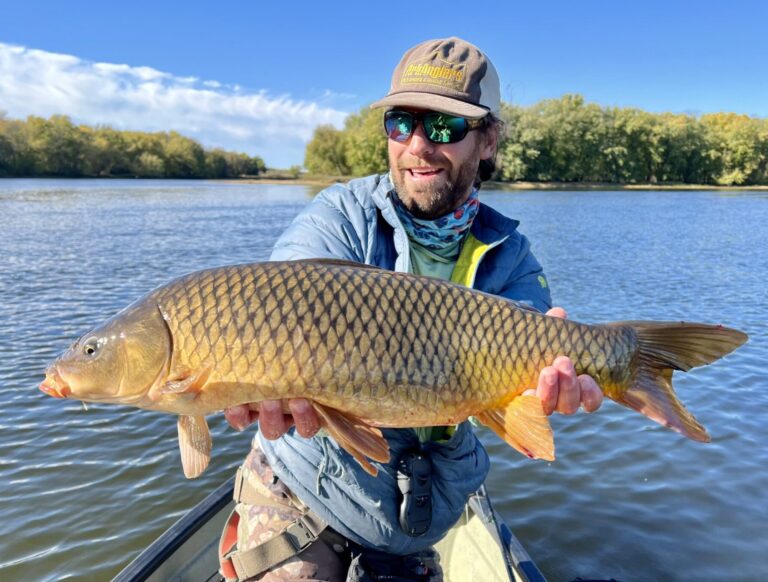
There’s a fish swimming in nearly every major river and lake system in Minnesota that most fly anglers walk right past.
It’s big and spooky. It feeds selectively and roots at the bottom like a bonefish. When you hook one on the fly, it will make you question every life decision that led you to believe you were a competent angler.
We’re talking about carp.
If you’re not taking them seriously, you’re missing out on one of the most technical and rewarding freshwater fly fishing experiences in the Midwest.
Why do so many fly anglers overlook carp?
Carp has an image issue.
When you think of them, you think of muddy bank fishing, corn bait, and treble hooks (lures with three points). In Europe, they’re revered as a sport fish. In the U.S., most folks still write them off as trash fish, a nuisance to be avoided rather than targeted.
That reputation could not be further from the truth.
Fly fishing for carp is closer to permit fishing (angling for a wary, tropical fish often found on shallow ocean flats) than it is to anything you’d do with a spinning rod and a bobber (a floating device that indicates fish bites). You’re sight-fishing (casting to fish you can see). You’re reading body language, current, and feeding behavior. You’re presenting a fly to a specific fish that can see you, smell you, and will spook at the slightest unnatural drag (movement on the water that fish sense as unnatural).
The margin for error is razor-thin. That challenge they bring is a huge part of why they really are a great fish to go after.
What makes Minnesota such a great place for carp fly fishing?
Minnesota doesn’t market itself as a carp fishery, which is exactly why it’s so good.
The Mississippi River fly fishing opportunities, the St. Croix, and the lakes around the Twin Cities hold enormous populations of common carp. These fish grow large in the rich, fertile waters of the upper Midwest. Fish weighing ten pounds or more are not rare. Some reach the high teens and low twenties.
More importantly, Minnesota’s carp experience little fly fishing pressure, as few anglers target them this way. Unlike fish in heavily targeted western tailwaters, these carp aren’t overly wary from repeated fly presentations. The window of opportunity is still wide open, and the fish are plentiful.
Spring and early summer are prime time. As water temperatures climb into the 60s, carp move to the shallower waters to feed, sometimes in water so skinny you’ll wonder how they fit. That’s when sight fishing for carp opportunities really start to open up.
On a calm morning, find a flat, sunny bank on the Mississippi, and you might see a dozen feeding fish move past you in an hour.
How do you successfully catch carp on a fly rod?
Carp on the fly demands precision in three areas: presentation, fly selection, and reading the fish.
Why is presentation so important when fly fishing for carp?
Presentation is everything.
Carp are ultra-sensitive to sound and vibration. A fly that lands even two feet off target, or with a hard slap, will blow a fish out of the zip code (cause them to flee). You need to deliver the fly softly, ahead of the fish, and let it sink naturally before they arrive.
Timing and distance judgment are critical.
What flies work best for carp?
Fly selection is more nuanced than most people expect.
Carp are opportunistic omnivores; they eat crayfish, aquatic insects, worms, seeds, and algae. But that doesn’t mean they eat everything. Match what’s on the bottom.
In the early season, crayfish and woolly bugger-style patterns work well. In warmer months, small nymph patterns and soft hackles that mimic invertebrates can be deadly.
That’s one of the benefits of going out with John; he knows what patterns are working when you’re out there and can help dial in the right carp fly patterns for the conditions.
How can you tell if a carp is ready to eat?
Reading the fish is the real skill.
A carp with its head down and tail up is actively feeding; that’s your shot.
A carp cruising below the surface is likely not feeding; intercept attempts usually spook it.
A carp sunning in shallow, warm water is in a semi-torpid state and nearly impossible to fool.
Reading posture and behavior before you cast separates consistent carp anglers from frustrated ones.
Want to learn how to fly fish for carp on the Mississippi River?
At The Ridge, guided carp fly fishing trips are some of the most exciting days we run.
John has spent decades fishing the Mississippi and knows exactly where these fish stage, feed, and hold throughout the season. Whether you’ve never targeted carp before or you’re looking to sharpen your sight fishing game, we’ll put you on fish and give you the technical foundation to make it happen.
Minnesota’s carp fishery is wide open. The fish are big, they’re there in numbers, and most anglers still aren’t paying attention.
Book a trip with The Ridge Fly Fishing and discover why carp have become one of the most respected species in modern fly fishing. Whether you’re looking to improve your sight-fishing skills, challenge yourself with a new species, or simply experience an overlooked fishery on the Upper Mississippi River, John will help you make the most of every opportunity on the water. Reach out today and reserve your date before the best seasonal windows fill up.