
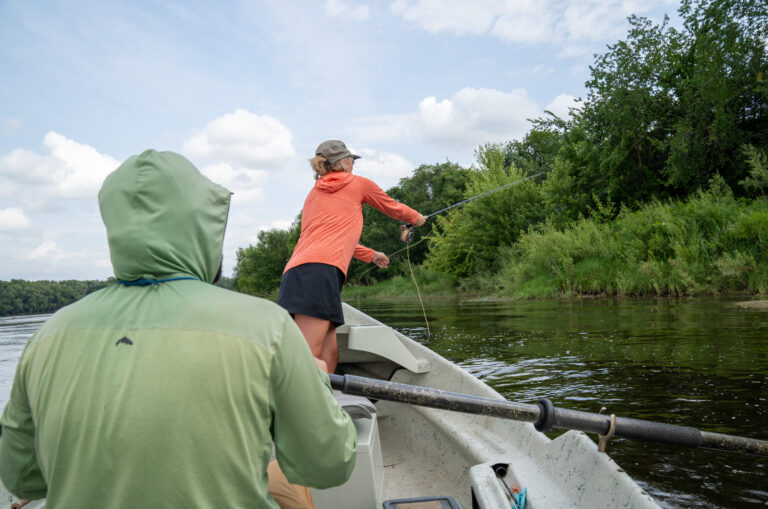
Suppose you’ve got a trip booked with The Ridge Fly Fishing; first, lucky you. You’re about to fish some of the most underrated water in the country, where a single day can put you in front of smallmouth bass, muskie, carp, and buffalo, sometimes all four. But before you start picturing a muskie eating boatside, get your cast dialed in before you show up.
Even a guide who knows every gravel bar and log jam on the river can’t do much if you can’t put the fly where it needs to go. The good news is you don’t need a river to get better. You can practice your cast just about anywhere: your backyard, a park, or in the parking lot at work on your lunch break. Here are some simple ways to show up ready to fish rather than working out the kinks on someone else’s clock.
Before you leave home, set up the rod you’ll actually be using.
Smallmouth on the river usually means a 6 or 7-weight. Muskie calls for something heavier, a 9 or 10-weight built to turn over big, bulky flies. Carp and buffalo are a different game entirely, often requiring a softer presentation on lighter tippet with the same accuracy demands as the smallmouth game.
If you’re booked for a multi-species fly fishing trip, get comfortable switching between rods so the feel isn’t foreign when John hands you a different setup on the water. Spend a few minutes a day on each, working short and medium casts in the 30 to 50-foot range. These fish don’t always give second chances, so accuracy matters more than how far you can throw it.
Lay out a few paper plates or old hats at 30, 40, and 50 feet. Practice landing your fly just past them and sliding it in quietly.
Carp and smallmouth holding on a sandbar or gravel flat can be every bit as spooky as anything you’ll find on tropical flats, so work on soft landings and tight, controlled loops. If your yard has trees or bushes, use them to simulate the log jams and overhanging cover you’ll be casting around on the river.
Focus on changing your angle and trajectory when you need to place the fly around cover.
River valleys aren’t always sheltered, and open stretches of water can kick up a stiff crosswind without much warning.
The best way to prepare is to practice on windy days instead of waiting for calm ones. Work on low, tight loops that cut through the wind rather than getting pushed around by it. Practice both forehand and backhand casts, and spend some time casting from your non-dominant side.
A little practice in the wind now can pay off in a big way when conditions aren’t perfect on the water.
Muskie fishing runs on seconds, not minutes.
A fish shows up trailing the fly toward the boat, your guide calls for a figure-eight, and you need to deliver the next cast fast and clean. Carp and buffalo work the same way. You spot a tail or feeding fish and often have one good opportunity before it moves off or spooks.
Practice this at home:
This builds the muscle memory that turns a rushed scramble into a confident cast.
Whenever possible, practice with a weighted fly or something close to it, especially if muskie are on the list.
Large articulated streamers load a rod very differently than a small dry fly or panfish popper, and you want that feeling to be familiar before you’re casting from a moving boat. Spend time managing your line in motion rather than simply casting on still water.
Practice stripping line, managing slack, and quickly recoiling line at your feet. These are the details that often matter most when a fish actually eats.
You don’t need marathon sessions.
Ten or fifteen minutes a day for a couple of weeks before your trip will do plenty. Consistency builds feel. You’ll start recognizing how each rod loads, how your timing improves, and how your loops tighten up naturally.
If you’re going with a buddy, spend some time calling out random distances:
“25 feet.”
“40 feet.”
“50 feet.”
It’s a simple drill that mimics how a guide calls shots from the bow and helps improve quick decision-making.
When you’re standing on the bow and John points out a smallmouth working a gravel bar, or a muskie comes out of the weeds and follows your fly to the boat, you’ll be ready. You’ll make that first cast with confidence instead of second-guessing it. You’ll stay composed when the wind picks up on an open stretch of river. And when that fish eats, you’ll be focused on the fight rather than fighting your own line.
That’s the payoff: more time enjoying the trip and less time fixing your cast. So grab your rod, find some space, and start practicing. The river’s waiting, and the fish don’t care if you’ve got jet lag, only if you can make the shot.
Ready to put those practice sessions to work? Book a guided trip with The Ridge Fly Fishing and spend a day chasing smallmouth bass, muskie, carp, and buffalo on some of the most underrated fly fishing water in the country. Whether you’re looking to learn the basics, improve your casting, or target a new species on the fly, John will help you make the most of every opportunity on the water. Reach out today and reserve your date before the best fishing windows fill up.